Turn how your business works into software you can prove.
Tavuni compiles your spreadsheets, rules, workflows and approvals into a working application — then checks every result against the source you already trust. AI can propose changes. Only people publish them.
No accountNothing uploaded — it runs in your browserThe real product, not a video
- Values checked
- 2,870
- Matched
- 2,869
- Rounding edge
- 1
- Different
- 0
The generated system, run on 590 records, agrees with the workbook’s own stored results on 100.00% of values.
- Excel
- =IF(D4="Cancelled",0,MAX(FreightMinimum,ROUND(I4*FreightRate,2)))
- Rule
- IF(Order.status = "Cancelled", 0, MAX(Setting.FreightMinimum, ROUND(Order.netAmount * Setting.FreightRate, 2)))
The rules that run your business are scattered — and nobody can prove a rebuild got them right.
Pricing lives in a spreadsheet two people understand. Approvals live in inboxes. Every new system re-types the logic by hand and is tested by whoever has time.
Logic nobody dares to touch
Thousands of formulas copied down rows, cross-sheet lookups, a hidden settings tab. It works — until someone inserts a column.
Decisions without a record
Who approved the discount, against which version of the rule? The answer is in someone’s email, if it exists at all.
Rebuilds that quietly change the numbers
Low-code tools and AI coding agents rebuild fast. None of them shows you evidence that the new system computes what the old one did.
Model. Generate. Govern. Verify. Evolve.
The business model is the source of truth. Everything people use is compiled from it, governed by it and checked against the source it came from.
Model
What the business keeps track of, how those things connect and how values are calculated — one Business Graph.
More about modelGenerate
The model compiles into a working application: records, lists, screens, reports and an API. No second copy of the rules in code.
More about generateGovern
Roles, record and field access, approvals and a tamper-evident audit trail — decided by the server, not hidden by the screen.
More about governVerify
Every calculated value is checked against the source you already trust. Differences are shown, never hidden.
More about verifyEvolve
A change arrives as a diff, runs against your real records, and is published by a person as a new version.
More about evolve
Formulas become rules about your business — not about cells.
From one example operations workbook — 10 sheets, 2,993 formulas, no hints — Tavuni found 7 record types, 6 relationships and 18 calculated fields, and compiled every one into a rule that names entities and fields.
Because the rules address Order and Customer instead of Orders!L4, they survive inserted rows and renamed sheets — and the original formula is kept beside each one, so any number can be traced back to the cell it came from.
- Excel
- =SUMIFS(OrderLines!$H$4:$H$383,OrderLines!$B$4:$B$383,A4)
- Rule
- SUM(OrderLine.lineTotal WHERE OrderLine.orderId = Order.orderId)
- Excel
- =IFERROR(VLOOKUP(E4,TaxRates!$A$4:$B$9,2,FALSE),DefaultTaxRate)
- Rule
- IFERROR(LOOKUP(TaxRate WHERE TaxRate.country = Order.shipCountry).taxRate, Setting.DefaultTaxRate)
- Excel
- =IF(D4="Cancelled",0,MAX(FreightMinimum,ROUND(I4*FreightRate,2)))
- Rule
- IF(Order.status = "Cancelled", 0, MAX(Setting.FreightMinimum, ROUND(Order.netAmount * Setting.FreightRate, 2)))
The 6 relationships as a list
Customer.segment→PricingRuleUplift.segmentCustomer.country→TaxRate.countryOrder.customerId→Customer.customerIdOrderLine.orderId→Order.orderIdOrder.shipCountry→TaxRate.countryOrderLine.sku→Product.sku
The workbook is the answer key.
Every spreadsheet stores the result of every formula as the application that last saved it computed it. Tavuni runs the generated system on the records alone — calculated fields blanked first, no cell addresses — and compares all 2,870 values.
2,869 matched. 0 differed. 1 sat exactly on a rounding midpoint, where two correct engines can legitimately disagree — so it is reported on its own line, not counted silently as a pass.
How verification works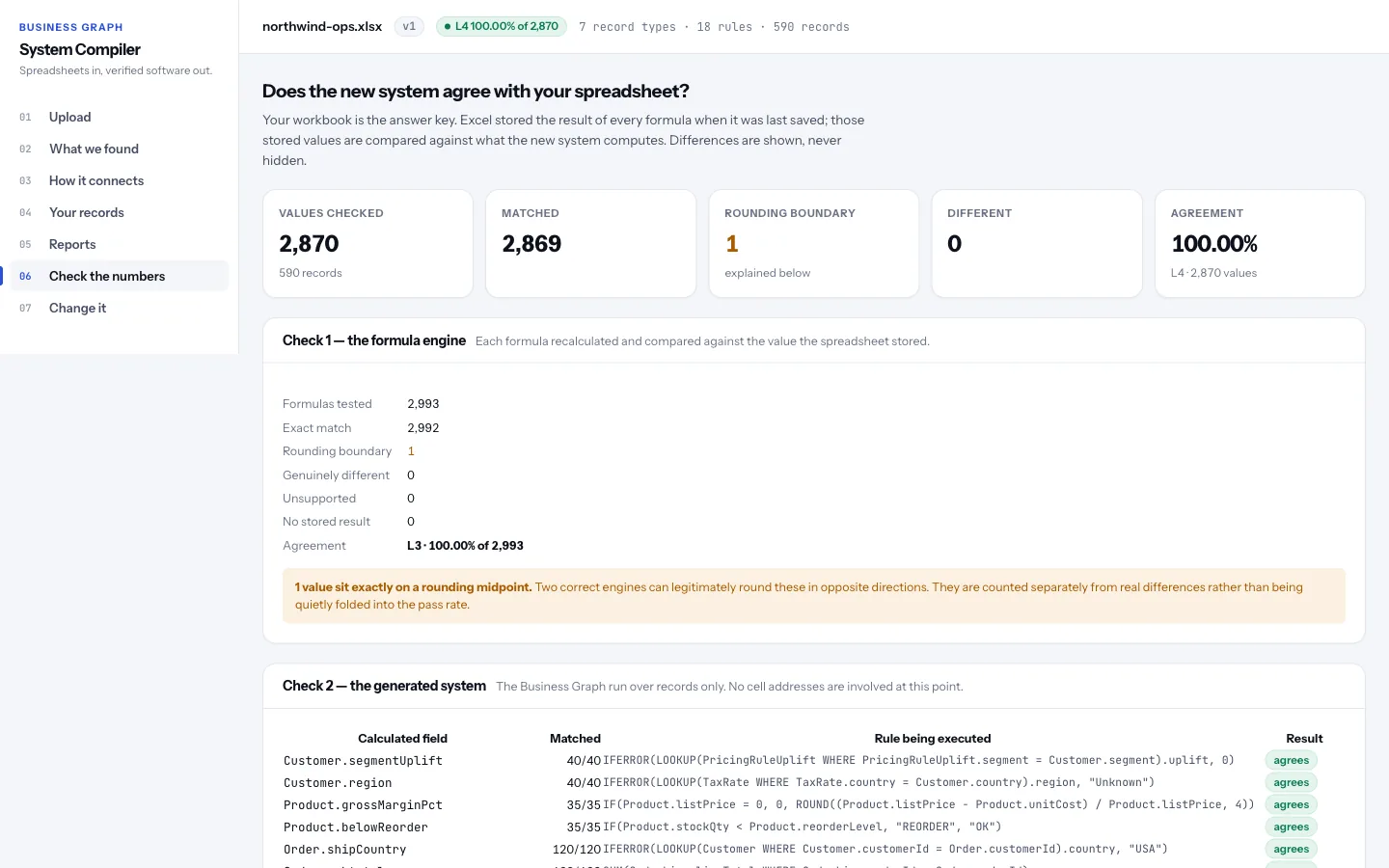
See exactly what a change will do — to your real records — before anyone publishes it.
Describe a change in plain language. It is worked out as operations on the model, checked for consistency, run against the records you already have, and shown as a before-and-after. The assistant cannot publish. A person decides.
In this public example the change is worked out by deterministic code on your device (local-heuristic (rule-based-v1)); no language model is called.
How safe change works- 1 · Request
Add a manager approval when order value exceeds $10,000.
- 2 · ProposalRequire Manager approval for orders over $10,000Assumptions it states, so a person can disagree:
- The threshold applies to Order.orderTotal (Order Total).
- Reusing the existing "Manager" role.
- The comparison is strictly greater than the threshold.
- 3 · Diff
- addedAdded rule "Orders over $10,000 need Manager approval": Order.orderTotal > 10000money or approvals
- addedAdded process "Order approval" with 4 stepsmoney or approvals
- 4 · Effect on real records89 of 120 Orders records (74.2%) would be affected.Combined order total of the affected records: $3,566,077.
- 5 · A person decidesThe assistant cannot publish. A person approves — and the change becomes version 2, with its author recorded — or discards it.
Then run the business on it — governed.
Beyond the compiler, Tavuni is a multi-tenant platform: the business model, the application people work in every day, and the controls around both. These are real screens from a seeded demonstration organisation.
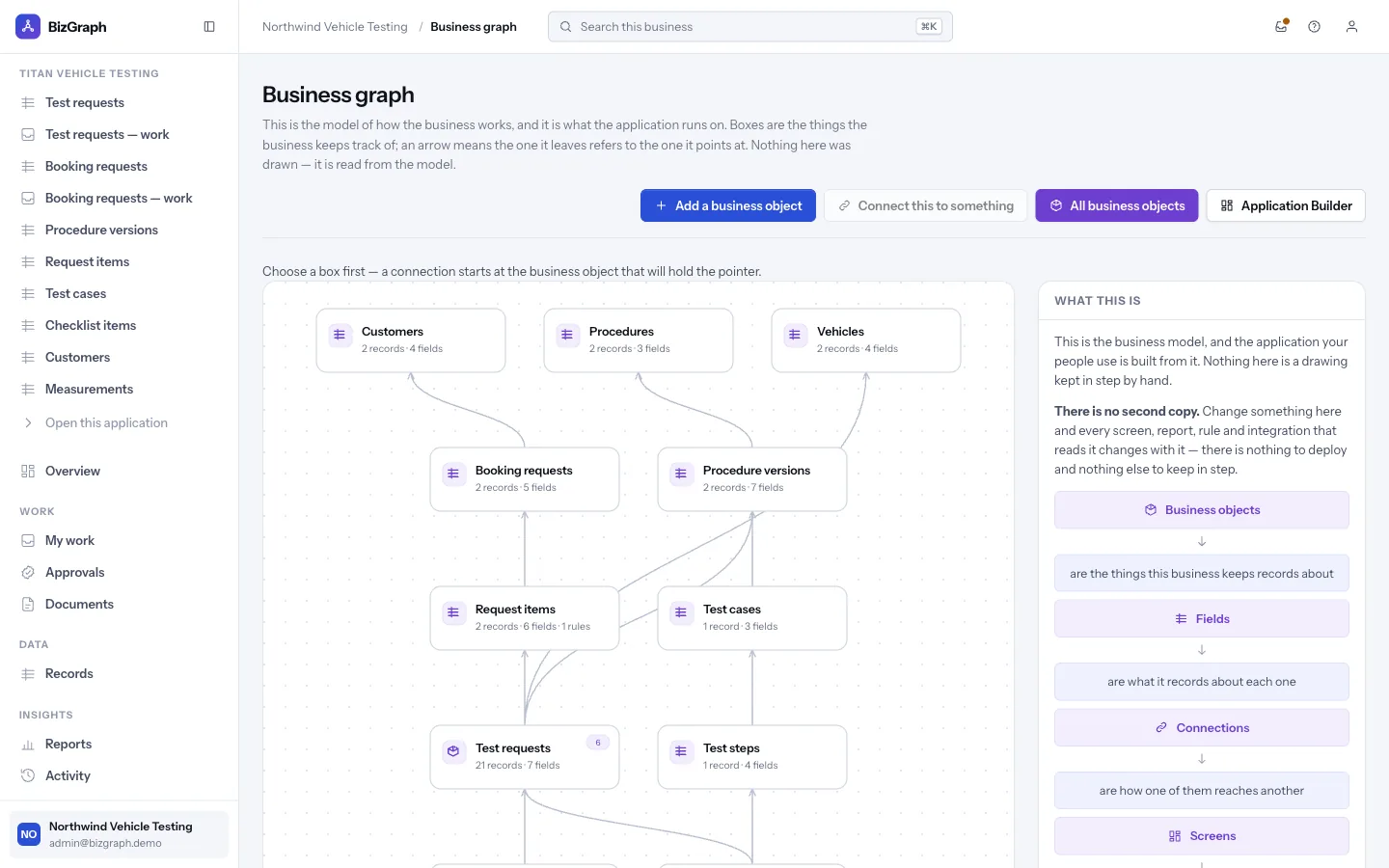
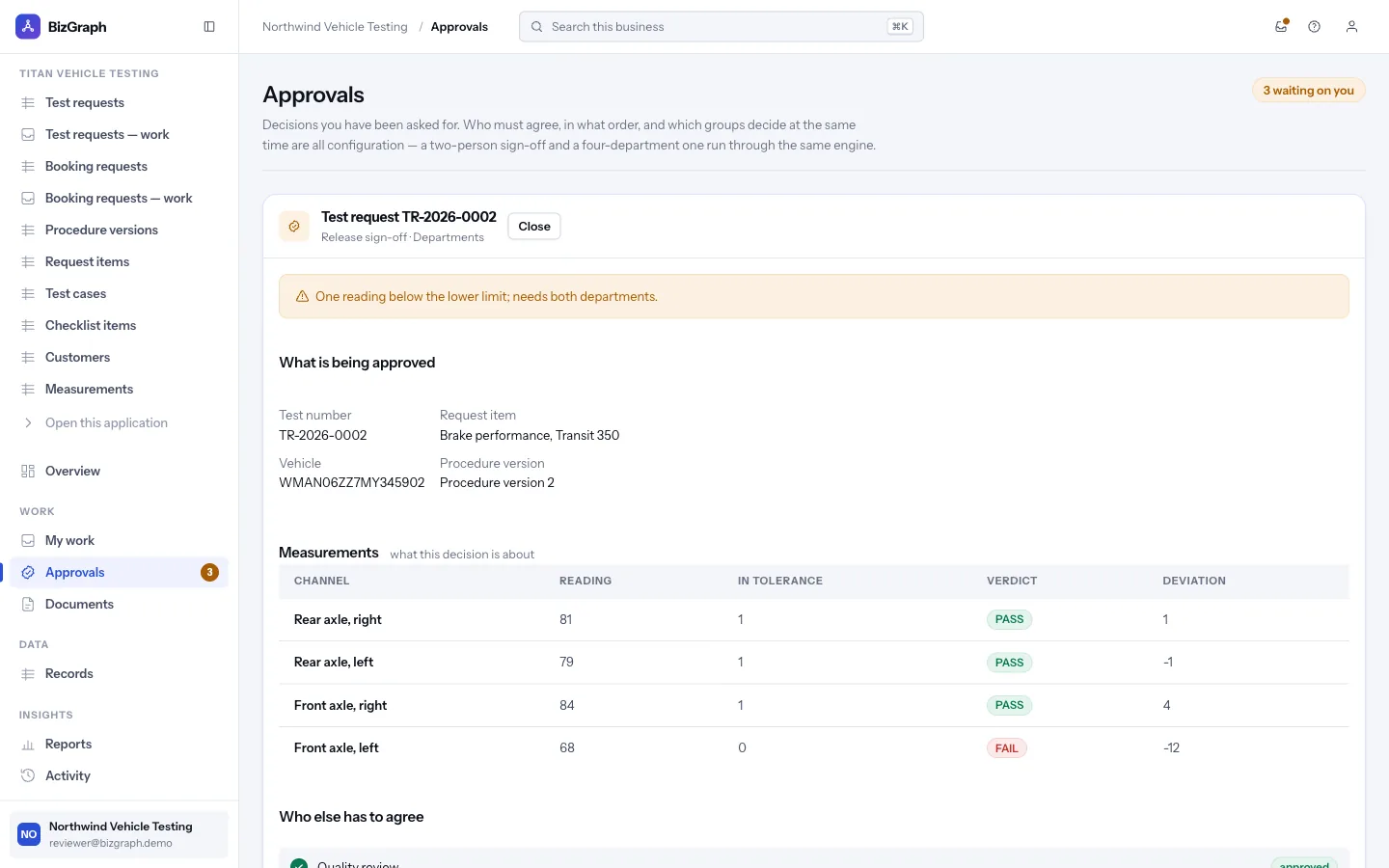
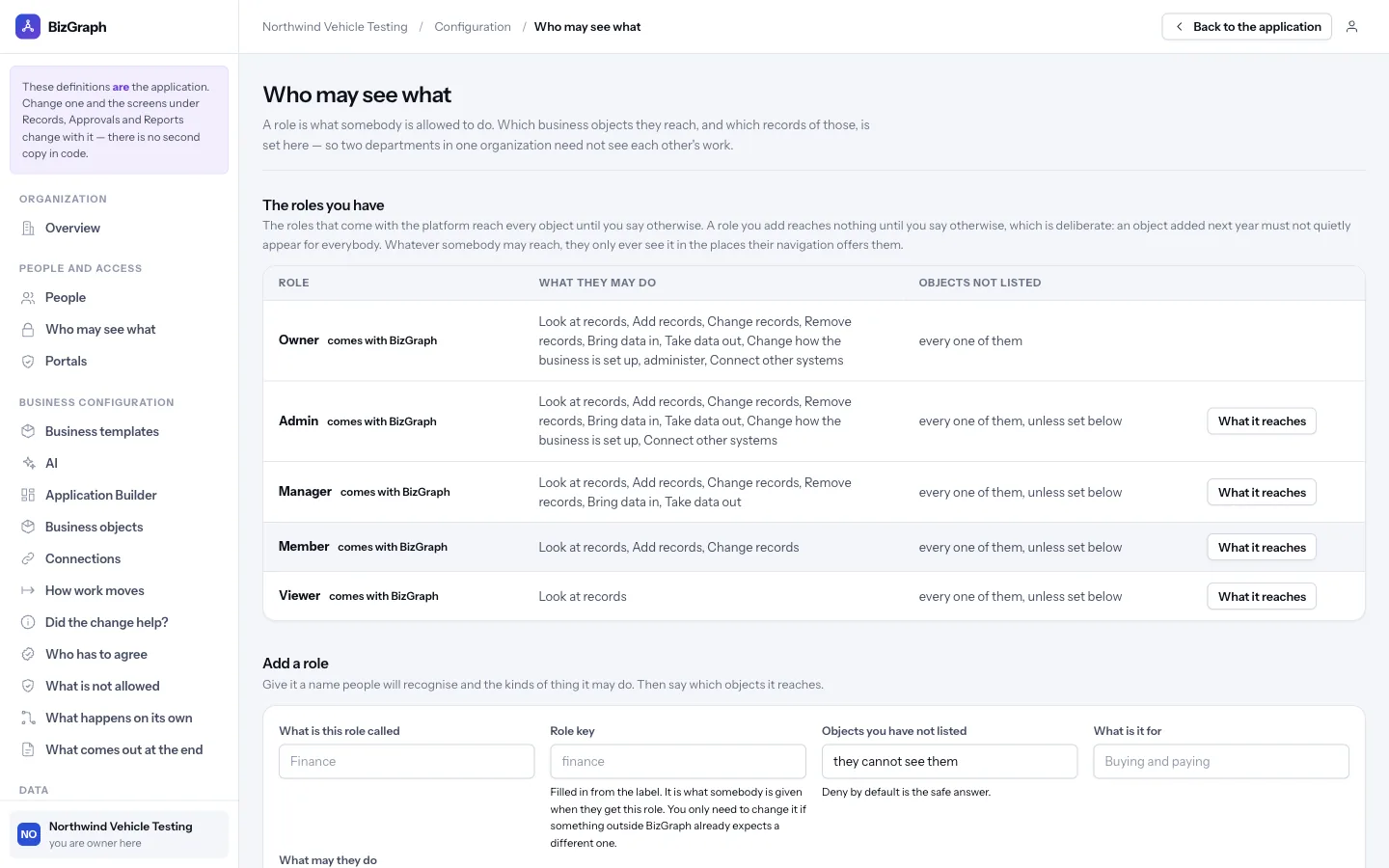
Built to be right, not just fast to a first screen.
Verified, not just generated
Low-code platforms and AI app builders leave correctness to manual testing. Tavuni checks every calculated value against an independent reference and shows every difference.
One model is the source of truth
Data, relationships, calculations, workflows, approvals and permissions in one Business Graph, compiled into the application. No second copy of the rules hidden in code.
Change you can see before it ships
A diff in business terms, its effect on your real records, and a person’s approval — then a new version, with its author recorded.
AI that cannot mark its own homework
The assistant proposes from a fixed vocabulary; deterministic code validates; each claim is traced to what was actually said. A model cannot publish, and cannot grade itself.
What buyers ask first.
Has anyone used Tavuni in production?
Not yet. The product is engineered and tested — over three thousand backend tests on SQLite and PostgreSQL, browser tests against a production build — but no business runs on it today. We are looking for one real process to pilot, and we say so on every page rather than imply otherwise. Talk to us about a pilot.
What if the AI gets something wrong?
The AI never edits your system. It may only propose operations from a fixed vocabulary — add a field, add a rule, add an approval step. Deterministic code validates them, applies them to a copy, runs them against your records and shows you the difference. Publishing is a person’s decision.
When the AI describes your business, every fact is traced to the sentence it came from, and it cannot claim that something was derived by the platform. How the AI is governed.
Can I see what a change will do before it goes live?
Yes. A change arrives as a diff in business terms — “added rule: orders over $10,000 need manager approval” — together with how many of your existing records it affects and what they add up to. Nothing is live until a person approves it as a new version. See the example.
Does it replace my spreadsheet, or sit beside it?
It replaces the spreadsheet as the system people work in, and keeps it as the answer key. Tavuni reads the workbook’s structure and formulas, compiles them into a model and rules, and checks the result against the values the workbook stored. Spreadsheet bugs are reproduced faithfully — the business runs on those numbers today — and that is said out loud, not hidden.
Which spreadsheet functions are supported?
178 of Excel’s roughly 500 functions, covering the lookups, aggregations, conditionals, rounding and dates that operational workbooks rely on. Every import produces a coverage report that names anything unsupported, and an unsupported formula is reported as such — never silently dropped.
Who can see what?
Access is decided by the server, not hidden by the screen. Roles carry explicit actions; record access can be all, own, team or none; individual fields can be restricted and are then never sent to a browser that may not read them. Organisations are isolated structurally, and asking for another organisation’s record answers “not found”. Governance in detail.
What does it cost?
There is no public pricing yet. During the pilot stage we agree terms with each pilot directly — tell us about your process.
Does my data train an AI model, and which provider is used?
The public demonstration sends nothing to any AI service. Inside the platform, AI is switched off until an administrator registers a provider and model for their organisation, with a monthly budget and every call metered. Whether that provider trains on your data is governed by your agreement with that provider — Tavuni does not train models.
See it work on a real workbook, in your browser.
The example operations workbook opens in Tavuni with no account and nothing uploaded. Every number on this site comes from that same pipeline.